Monolithic crowns have definitely become the buzz word of the dental industry in recent months. By definition “monolithic” means it is fabricated in full contour out of a single material. Traditionally crowns are made with a strong substructure of metal or zirconia. Both of these materials are very strong and virtually unbreakable. These substructures, or copings, are then veneered with a porcelain to full contour to give esthetics and function. If fabricated properly these restorations can function for many years, however they can fail due to two inherent weak spots. The interface between the coping and the porcelain veneer, and the veneering porcelain itself (90-110mpa) are both much weaker the coping itself. If anything is going to give it will be the porcelain itself.
A monolithic crown eliminates the layer of a weaker porcelain over the crown thereby making the crown much stronger.
The two options available for monolithic crowns right now are IPS e.max, and Full Contour Zirconia restorations.
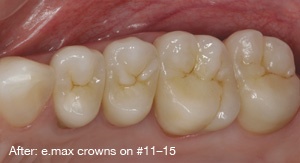
IPS e.max Lithium Disilicate is a “monolithic” glass ceramic restoration. It offers dentists improved fit, improved esthetics, and improved durability (400mpa). Metal, zirconia, resin, and conventional feldspathic porcelain still have an important role, but e.max is perhaps the most versatile and chip resistant option available. It can be “pressed” or milled using a CAD/CAM system into full contour. It has no interface, and no layered veneer. And because the ceramic ingots are blended with dentin colored and translucent ceramics, these posterior crowns match posterior dentition with slight translucency in cusp tips. They are customized with paint-on shades and then a layer of glaze for a final shine.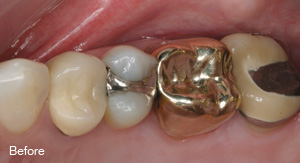
 Full Contour Zirconia is exactly what it says, a crown made to full contour of solid zirconia. Although much less esthetic than e.max, it is far stronger (800-900mpa) and therefore well suited to withstand severe parafunctional activity. With these virtually unbreakable crowns, you can offer your patients the strength to withstand severe bruxing and avoid metal restorations. These crowns can only be made by CAD/CAM. They are milled from a block of “green” zirconia, infiltrated with a special coloring liquid and then sintered at 1500 C in a special oven. They are then customized with paint-on shades, polished, and then covered with a layer of glaze for a final shine.
Personally, I see the demand for monolithic crowns growing every day. E.max is such a versatile material and is only getting better. It is available in various levels of translucency and all the Vita Classical shades. It is also perfect for thin or “no-prep” veneers because of it’s strength, and when a layer of translucent porcelain is applied to the labial it results in an extremely esthetic restoration. (see our gallery) I have seen very few failures with e.max and in my opinion they can all be attributed to not following preparation guidelines (see our resources page) or experimenting with bridges in locations not indicated.
Full contour zirconia is surprisingly popular also. It is not the most esthetic option but it is very strong, and so a great choice for posterior teeth. I am told newer, more translucent zirconias should be showing up soon but until then ours are looking pretty good. We’ve had a few glitches getting these crowns to this point, mostly a defective sintering furnace that would leave the crowns looking very opaque, but now with a new furnace we feel pretty confident in full contour zirconia. Make sure you know what you are doing with zirconia because it is such a hard material. You don’t want to have to cut one of these suckers off. Also, if you need to adjust the occlusal surface you MUST polish it back to a high shine or it can be very abrasive to the opposing tooth.
At Oral Design Dental Laboratories Inc. we offer both e.max & full contour zirconia crowns.